



A shared precision workspace
Two independent tool chains are designed to work at the same microscope sample, connecting observation and physical interaction.
 Frog WorksAutomationLet’s talk
GANYMED / THE PLATFORM
Biological workflows change. Your robotics should be able to change with them. Ganymed brings imaging, manipulation and sample handling into one reconfigurable architecture.
Inside the platform01 / THE ARCHITECTURE
Robotics, vision and control form the core. Tools, modules and protocols adapt to the application.
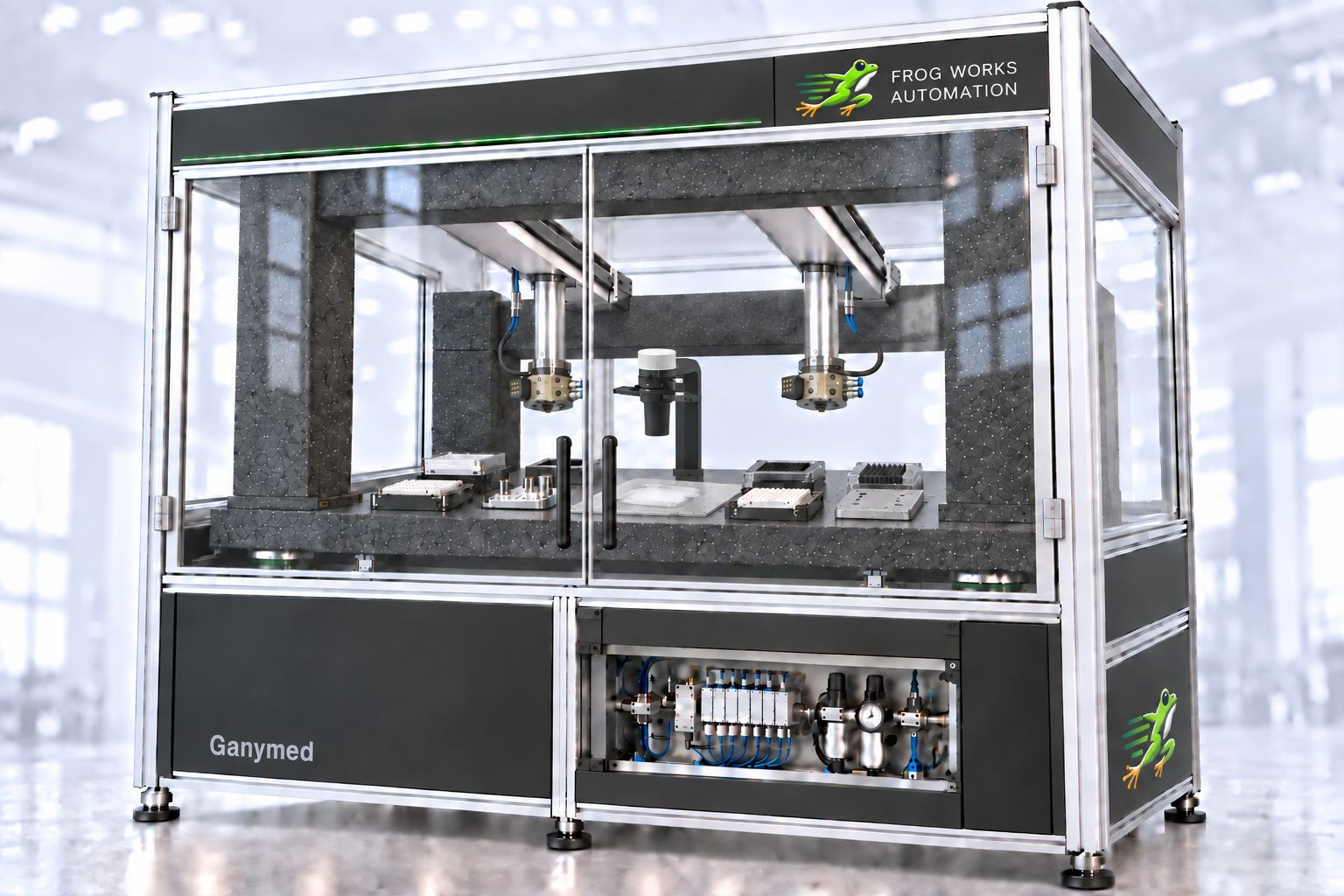
Two independent tool chains are designed to work at the same microscope sample, connecting observation and physical interaction.
Automatic tool exchange and a modular worktable allow the system to adapt to different samples, instruments and protocols.
Reusable capabilities connect tools and laboratory equipment into workflows. Local vision and AI support the operator, with deterministic control and safety on separate layers.
Integrated microscopy and computer vision bring the sample into focus.
Precision robotics to position, pick, inject and probe at the cellular scale.
Small-volume liquid handling for washing, preparing and transferring precious samples.
Exchangeable tools and modules let the platform evolve with the workflow.
02 / THE DEVELOPMENT PATH
Our first-generation approach puts the expert in control. Automation grows through validated workflows.
The expert decides. The platform executes controlled, repeatable movements.
Validated operations are combined into multi-step protocols.
Vision and sensing support increasingly automated workflows as each application matures.
03 / POSSIBLE APPLICATIONS
We are exploring applications where scarce material and demanding physical tasks make precision especially valuable.
Selecting, isolating and preparing individual cells for low-input research workflows.
Exploring imaging-guided selection, enrichment and transfer of scarce biological material.
Precision positioning and microinjection as building blocks for research protocols.
These are areas of development, not validated product applications. Capabilities and performance require application-specific evaluation.
LET’S CONNECT